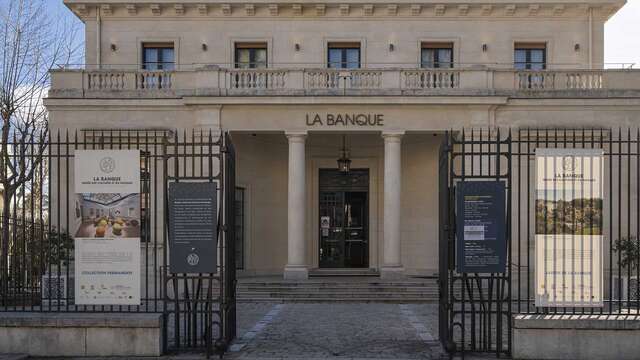




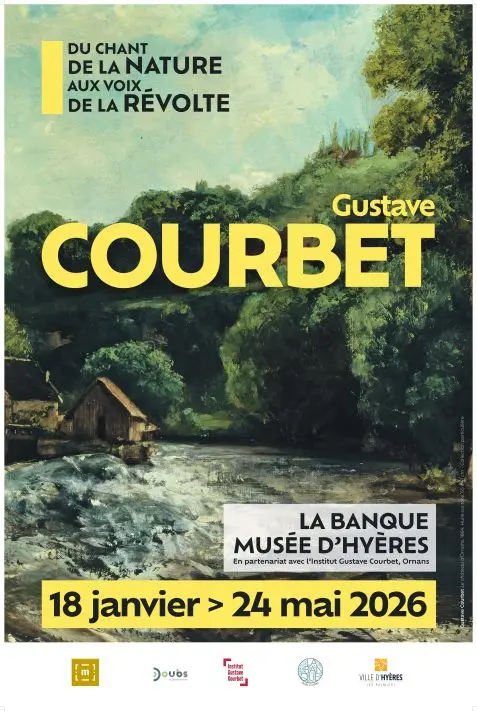
The Gustave Courbet exhibition "From the Song of Nature to the Voices of Revolt", in partnership with the Institut Courbet, Ornans.
Gustave Courbet (1819-1877) is one of the giants of the XIXᵉ century.
A visionary painter and the foremost exponent of Realism in painting, he created such legendary canvases as Un Enterrement à Ornans, L'Atelier du peintre, L'Effaré and L'Origine du monde. But behind these masterpieces lies a multiple artist, deeply rooted in his native land and at the same time open to the horizons of the world.
Born in Ornans, Courbet remained attached to the Franche-Comté region all his life. Landscapes play an essential role in his work, accounting for almost two-thirds of his output. His landscapes,
which he wanted to be universal, convey the soul of the sites he loved - the Source de la Loue, the Puits Noir, the cliffs of the Jura. But he also opened his eyes to other horizons. The sea, which he discovered in Le Havre in 1841, became a revelation: "The sea, with no horizon, how funny for a valley-dweller. From the Loue to the Léman, from the English Channel to the Mediterranean, water became for him a symbol of movement, freedom and escape.
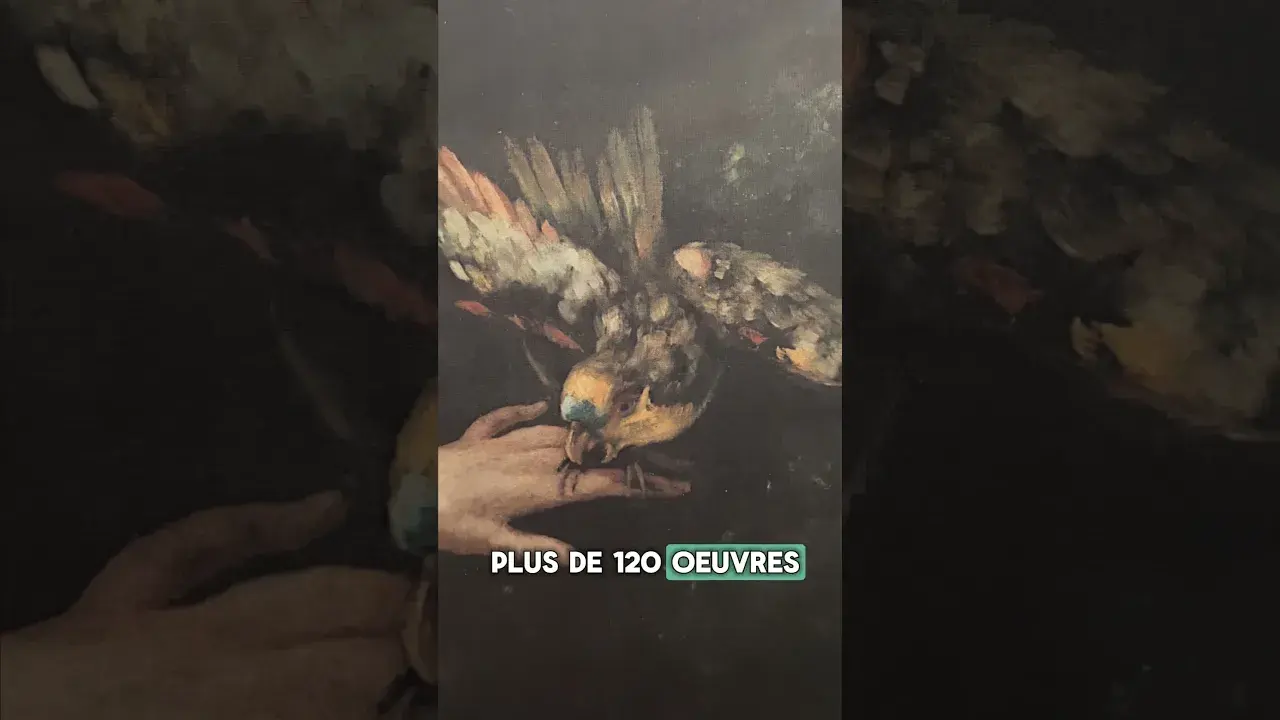
A painter of hunting and fishing, Courbet also focused on the animal world, which he portrayed with an almost carnal acuity: deer lurking in the shadows, foxes caught in traps, hunting scenes captured in all their dramatic intensity. His eye also turns to the human. Ode to women in portraits of magnified sensuality, celebration of the faces
faces of peasants and workers, he conveys the strength, dignity and sometimes suffering of the humblest of people.
A free and often rebellious artist, Courbet paid dearly for his convictions. His role in the Paris Commune and his participation in the debunking of the Vendôme column exiled him to Switzerland, where he ended his life in pain and solitude. His flamboyant personality, both admired and contested, inspired countless portraits and caricatures.
This exhibition explores all the facets of Gustave Courbet, an unclassifiable painter - a lover of landscapes, a champion of women, an observer of the animal world
but also a committed man for whom art was a real struggle. The exhibition brings together 122 works by Courbet and artists of his time, including almost 40 oils on canvas, as well as drawings, engravings, caricatures and other works of art.
drawings, engravings, caricatures, old photographs, a handwritten letter and personal objects by the artist.
Accessibility
Mental disability
Accessible for wheelchairs with assistance
Accessible for self-propelled wheelchairs
Reserved space 330 cm wide < 100 m from the site
WC + grab handle + adequate space to move
Reception staff sensitized to the reception of people with disabilities
Rates
From 18 January 2026 to 24 May 2026
From 18 January 2026 to 24 May 2026
Reduced price
€4.00
Adult
€7.00
Opening times
From 18 January 2026 until 24 May 2026
From 18 January 2026 until 24 May 2026
Monday
Closed
Tuesday
14:00 - 18:00
Wednesday
10:00 - 13:00
14:00 - 18:00
Thursday
14:00 - 18:00
Friday
14:00 - 18:00
Saturday
10:00 - 13:00
14:00 - 18:00
Sunday
14:00 - 18:00
Medias
visite de l'exposition gustave courbet au musée de la banque à hyères![visite de l'exposition gustave courbet au musée de la banque à hyères]() Missing video caption
Missing video caption
Location
Contact Gustave Courbet "From the Song of Nature to the Voices of Revolt".
- www.provencemed.com
- Website
Spoken languages
Spoken languages