



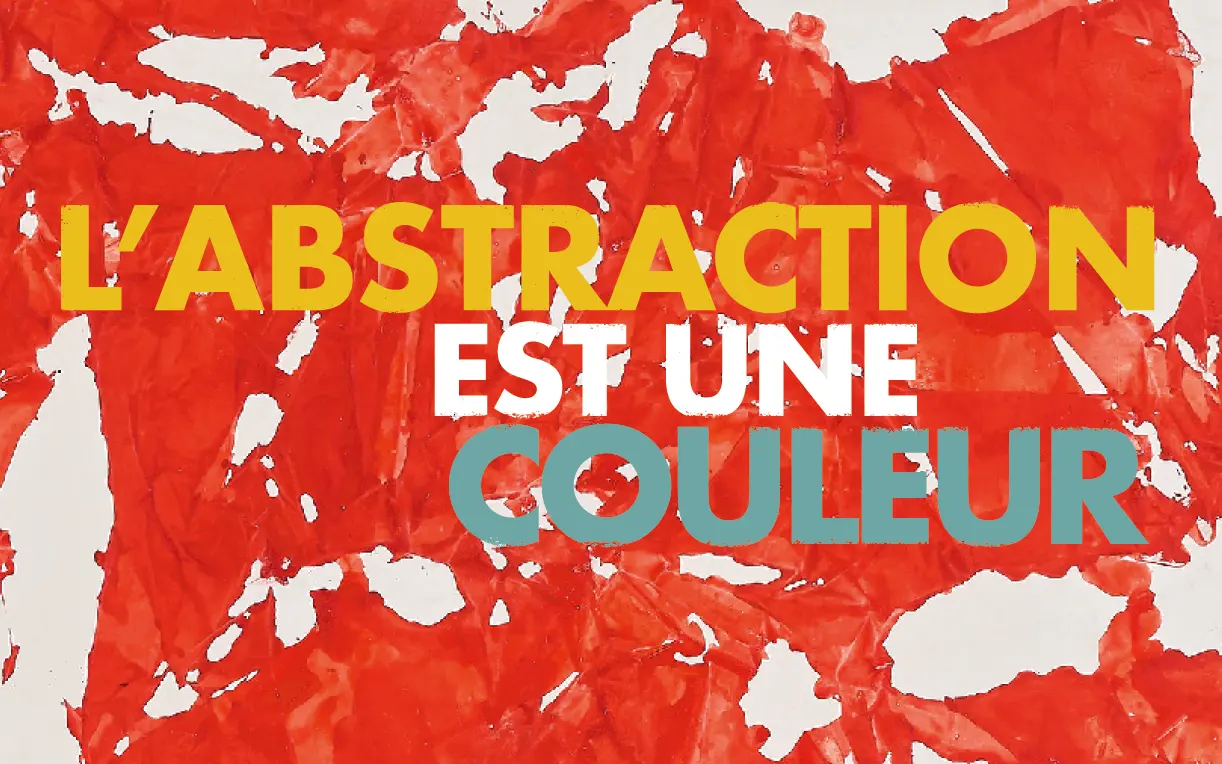
This exhibition highlights the relationship between color and abstraction in the second half of the 20th century. Color struggled to establish itself in post-war abstract expression, in an aesthetic context unfavorable to the use of bursts of color.
In 2026, we present a new facet of the Musée du Niel collection. After the origins of the collection around Jean Grenier's book, entretiens avec 17 peintres non figuratifs, in 2023, after the confrontation of Deux avant-gardes, la Nouvelle École de Paris and Supports/Surfaces in 2024, after Dubuffet et les magiciens in 2025 and its rather figurative evocations, in 2026 we approach abstract expression from the angle of color with L'abstraction est une couleur.
The aim of this exhibition is to highlight the relationship between color and abstraction in the second half of the twentieth century. These relationships are marked by a struggle, a combat. Color struggled to assert itself in post-war abstract expression, in an aesthetic context that did not readily accept the use of bursts of color. The dominant chromatic codes were often dark, rarely escaping black, white and gray.
Some, like Dewasne, manage to impose their colorful vision through geometric expression, or through lyrical power, like Mathieu, Schneider, Poliakoff, Hartung, and today Fabienne Verdier, or through color itself as a central element of the work, as with Hantaï. On the other side of the Atlantic, there are artists who strongly assert their Matissian heritage and make color the essential component of their abstract work, while at the same time reinventing painting. Such is the case of Shirley Jaffe and Sam Francis, or Kimber Smith and James Bishop.
From these struggles, this resistance, this rebirth, these interconnections, emerge a sensation, a feeling, even a language, bright or dark, that can be described as "color abstraction".
Text: Antoine Villeneuve, exhibition curator.
The aim of this exhibition is to highlight the relationship between color and abstraction in the second half of the twentieth century. These relationships are marked by a struggle, a combat. Color struggled to assert itself in post-war abstract expression, in an aesthetic context that did not readily accept the use of bursts of color. The dominant chromatic codes were often dark, rarely escaping black, white and gray.
Some, like Dewasne, manage to impose their colorful vision through geometric expression, or through lyrical power, like Mathieu, Schneider, Poliakoff, Hartung, and today Fabienne Verdier, or through color itself as a central element of the work, as with Hantaï. On the other side of the Atlantic, there are artists who strongly assert their Matissian heritage and make color the essential component of their abstract work, while at the same time reinventing painting. Such is the case of Shirley Jaffe and Sam Francis, or Kimber Smith and James Bishop.
From these struggles, this resistance, this rebirth, these interconnections, emerge a sensation, a feeling, even a language, bright or dark, that can be described as "color abstraction".
Text: Antoine Villeneuve, exhibition curator.
Opening times
Opening times
From 2 May 2026 until 1 November 2026 - Open everyday