©FDAAPPMA06

Discover fishing in the Alpes Maritimes

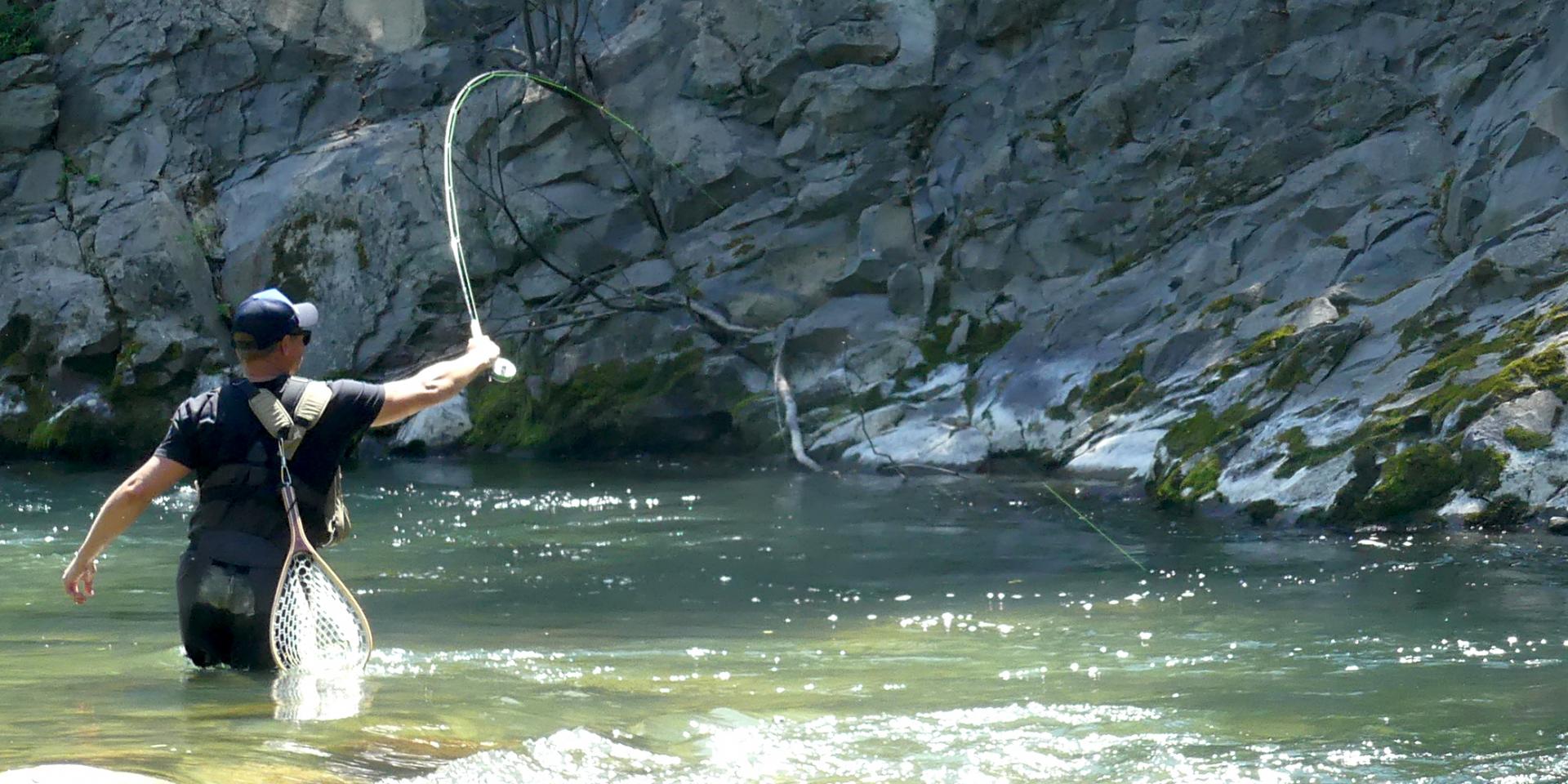
Here, the mountains meet the Mediterranean: an angler’s dream come true! The steep gradients over short distances give the catchment areas of the rivers and streams a torrential character: welcome to the kingdom of the fario trout!

In 2026, fishing will be fully reopened on the Roya and partially reopened on the Vésubie. Full details in the 2026 guide.

Siagne Valley

Fish one of the jewels of our region, with its crystal-clear, emerald-green waters in a wild, unspoilt setting!

The Siagne is classified as a 1st category river from its source to the Tanneron bridge. Its alternating riffles and deep pools make it an exceptional river for big trout.

The Siagne is easily accessible from the Pont de Siagne and the Pont des Veyans, where interdepartmental discovery fishing routes have been set up. These routes are perfect for discovering fishing on the Siagne or learning a new technique.

Downstream of the Tanneron bridge, perch, pike, roach, carp, tench and …. populate the deeper areas, while the riffles are the preferred areas for stalking the large chub, which are abundant.

A river that’s well worth a look – you won’t be disappointed by the scenery!

www.peche06.fr

Vallée du Loup

Wild Mediterranean trout over a stretch of almost 50 km, from the springs to the coast!

The upper reaches of the river offer bucolic fishing in an unspoilt mid-mountain setting: clear waters from resurgent springs flow down to the Pont du Loup between the rocks, forming magnificent pools populated by wild fario trout.
The lower reaches of the Loup, classified as second category from Le Lauron onwards, are accessible to all: this sector is still home to a good population of fario trout. But it’s also an ideal spot to introduce children to the joys of fishing, as the population of minnow, blageon, chub and barbel can be caught with a simple rod and reel, leaving no time for novices to get bored.

www.peche06.fr

Cagne Valley

Ideal for getting closer to nature without straying too far from the coast

The Cagne flows through a wild landscape from its source at Coursegoules to the Pont des Salles, upstream from Cagnes-sur-mer. It’s the perfect spot to get away from it all (literally and figuratively!) and recharge your batteries by the water’s edge, at the foot of the St Jeannet bay, just a few kilometres from the coast. Despite the numerous waterfalls and a number of short, narrow stretches, the river is fairly easy to navigate thanks to the many small paths that run along its length. All techniques are suitable for trout fishing, which is very common on the Cagne. Downstream of the former hydroelectric plant at La Gaude, the river is classified as category 2, and fishing is available all year round!

www.peche06.fr

Esteron Valley

The longest “wild river” in France

Fishermen, you’re on the banks of the Esteron in an exceptional, unspoilt setting. The river has been designated a “wild river” from its source to La Clave!

This waterway, which is little affected by human activity, is home to magnificent fario trout of a particular genetic strain, treasures of our local natural heritage.
All fishing techniques can be used along this sumptuous river, which is a succession of large, deep flats and riffles on its flatter sections, interspersed with large dunes and waterfalls in the creek sections.

www.peche06.fr

Cians Valley

Fishing in the “red”, a unique experience in France!

The Gorges du Cians, like its neighbour “Le Colorado Niçois” at Daluis, are carved out of red schist and are a major tourist attraction in the département.
The river and its tributary canyons are particularly well stocked with brown trout.
At the start of the season, give preference to moths, the insect larvae that are a popular natural bait for trout. Summer is a great time for fly fishing.
Fishing in these breathtaking landscapes does, however, require some precautions, as water levels can rise rapidly in the event of a storm.

www.peche06.fr

Tinée Valley

A varied playground: a wide, accessible river, secret valleys and perched mountain lakes

The Tinée enjoys an excellent reputation, not only for the beauty of the wild landscapes in its catchment area, but also for its wealth of fish: the river is home to a very high density of brown trout, with courses to be explored using flies, natural bait or casting. When we talk about the Tinée, we shouldn’t forget its many tributaries, which are densely populated with fario trout, as well as the high altitude lakes that reward the angler/hiker.

www.peche06.fr

Var Valley

The river torrent, a link between the Mercantour and the Mediterranean

From its source at the foot of La Cayolle to its mouth on the Mediterranean at Nice, the river offers a varied landscape.
In terms of fishing, the lake at the source of the Var, bordered by larch trees, is particularly suitable for a family activity at an altitude of 1,800 m on the banks of the legendary Grandes Alpes road.
Further down, on the middle Var, the river has long riffles interspersed with deep flats: there aren’t many safe havens, but they are home to some very big fish.

www.peche06.fr

Vésubie Valley

In 2026, fishing is open on all the territories of the AAPPMAs, with the exception of certain sectors of the Vésubie and its tributaries.

The Gordolasque, the main left-bank tributary of the Vésubie, stretches for around 19 km from the foothills of the Gélas. Renowned as one of the most emblematic rivers in the Alpes-Maritimes, its spectacular scenery and high fish population make it a real attraction. It’s also a great starting point for many hikes in the Mercantour National Park.

Today, trout populations are as dense as they were before Storm Alex. The Haute Madone, which remained intact after the storm, is also open to fishing.

The high plateaux of the Gordolasque and Madone de Fenestre are ideal for fly fishing. Natural bait and lure fishermen also find excellent conditions here, particularly outside low-water periods.

Roya Valley

In 2025, fishing will be fully reopened on the Roya, including several tributaries and emblematic courses.

Thanks to the dynamic re-colonisation of the river by trout, fishing will be fully accessible on the cross-border no-kill route.

The five tributaries of the Roya (Levenza, Bergue, Ceva, Cairos and Bendola) offer unique experiences: their valleys and canyons, often nestled in impressive gorges, are home to many large fish.

Adventure guaranteed!

Interactive map