




Description
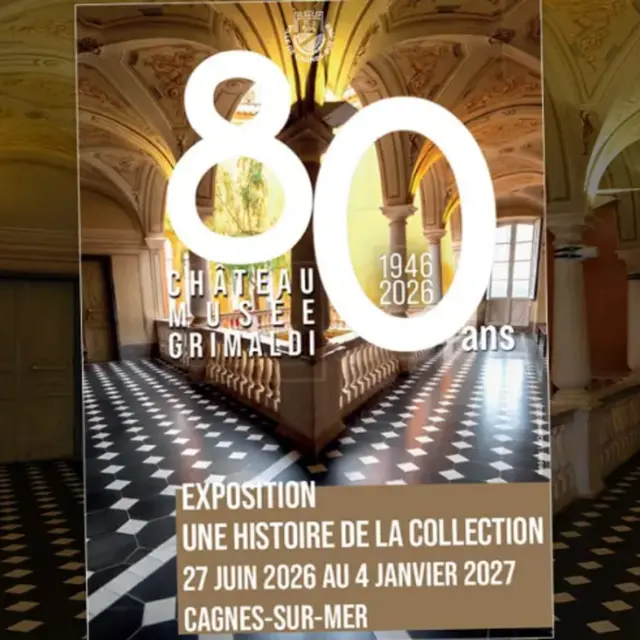
From June 28, 2026, to January 4, 2027, the Grimaldi Castle Museum will present an anniversary exhibition that traces the unique history of its founding and its collection.
In fact, it was 80 years ago, in 1946, that the local government of the time decided to convert the castle—which it had acquired in 1937—into a museum and open it to the public.
The task proved immense: when it was first established, the Château-Musée had no collection whatsoever.
A curator, Denis-Jean Clergue (1906–1981), was hired to take on the challenge. Determined and persevering, he was the driving force behind the expansion of the collection, which today comprises approximately 1,800 works and objects, including some masterpieces of art history (Portrait of Suzy Solidor by Tamara de Lempicka (1898–1980)).
Visitors to the Château-musée are invited to discover or rediscover this collection, its unique history, its diversity, and its richness. Films, photographs, and archival materials will complement the exhibition of the works.
The exhibition is located on the second floor of the Château-musée. It comprises four sections:
The Founding of the Olive Museum
Noting that olive cultivation was in decline on the French Riviera, Denis-Jean Clergue set out to preserve the memory of olive farming and to celebrate the nobility of the olive tree. Despite the material hardships of the immediate postwar period, he collected and acquired jars, olive presses, millstones, and precious olive wood objects that enabled him to found the Olive Museum, which can still be seen today.
The Creation of a “Fine Arts” Collection and the Generosity of Artists
The vibrant artistic life of the French Riviera that characterized the 1950s and 1960s did not escape Clergue’s keen eye.
But due to a lack of funds—Cagnes was still a small town at the time—he could not make purchases.
Driven by his passion for painting, he secured generous donations from the artists he promoted during temporary exhibitions: Moïse Kisling (1891–1953), Roger Chastel (1897–1981), Tsuguharu Foujita (1886–1968), and others donated works to the château.
The International Painting Festival, a unique adventure
In 1969, modeled after the Cannes Film Festival, Cagnes created an international painting festival in partnership with the Ministry of Foreign Affairs. The Château-Museum then opened up to the world, and the collection grew, thanks to donations, with contemporary works: thus, Vasarely’s (1906–1997) mesmerizing “Jazz Collage” entered the collection! The festival came to an end in 2001.
Major donations and exceptional acquisitions
In the 1970s, the energy Clergue devoted to promoting the château also attracted collectors.
Notably Suzy Solidor (1900–1983), who donated her collection of portraits in 1973, which included several masterpieces (Tamara de Lempicka – Portrait of Suzy Solidor, Tsuguharu Foujita – Untitled, Christian Berard (1902–1949) – Untitled, Marie Laurencin (1883–1956) – Untitled, etc.). The reputation of the Château-musée Grimaldi was thus established.
Much later, in 2003, another major donor decided to donate his collection of portraits: the poet, artist, and critic André Verdet (1913–2004).
Through this gesture, he introduced, for example, Ben (1935–2024) into the château’s collections.
Today, the city is no longer left behind and, as opportunities and resources allow, acquires works of particular interest to the artistic history of Cagnes: *Haut-de-Cagnes* by Yves Klein (1928–1962), Black and White Cat by Tsuguharu Foujita, a portrait of a woman by Marie Vassilieff (1884–1957), Madame Steanlet with a Rose.
Rates
Full price: €4
Free on the 1st Sunday of the month, for Cagnois and under-26s.
Double ticket (applicable to those wishing to visit both the Château-Musée and the Musée Renoir on the same day): €8.
Free on the 1st Sunday of the month, for Cagnois and under-26s.
Double ticket (applicable to those wishing to visit both the Château-Musée and the Musée Renoir on the same day): €8.
Opening times
From 3 July 2026 until 4 January 2027 - Closed on tuesday
October to March: 10am-12pm and 2pm-5pm
September, April, May, June: 10am-12pm and 2pm-6pm
July and August: 10am-1pm and 2pm-6pm
Jazz Fridays at the Château: open until 7pm
September, April, May, June: 10am-12pm and 2pm-6pm
July and August: 10am-1pm and 2pm-6pm
Jazz Fridays at the Château: open until 7pm
