



Description
"The presentation is sober and meticulous, with no search for "effects" [...]. In short, it's nothing like a museum-clinic, but a succession of peaceful rooms [...].
Visitors shouldn't expect to see the grand interiors of the early days, the Fauvist landscapes, the gleaming still lifes, but rather imagine that they have the chance to visit Matisse's studio."
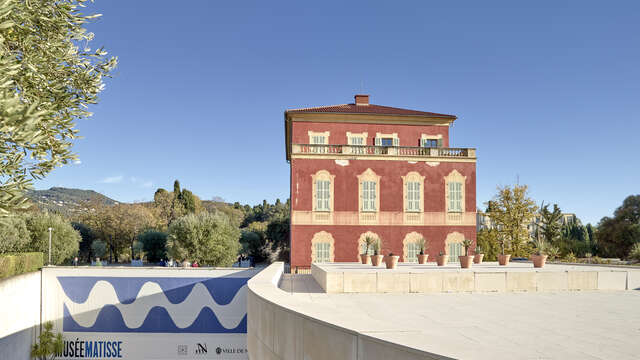
These words, taken from an article dedicated to the opening of the museum, aptly illustrate what characterizes the museum and its uniqueness.
The fruit of a singular history, the museum's collection was built up thanks to the generosity of Henri Matisse (1869-1954) and his family. In 1953, a year before his death, the artist gave the City of Nice a group of works that formed the basis of today's monographic museum, including Oceanie, la mer (Oceania, the sea) and Océanie, le ciel (Oceanie, the sky) (1946). Amélie Matisse, his wife, completed this collection in 1960 with a bequest of paintings, such as Nu au fauteuil (1936-1937), and almost a hundred drawings. The artist's children - Marguerite, Jean and Pierre - and their heirs have continued the legacy by donating sculptures, engravings, illustrated books, ceramics and cut-out gouaches, such as the preparatory work for the chasubles in the Chapelle du Rosaire in Vence. The collection is also enriched by many of the artist's personal objects, models and protagonists in his work.
Stemming from Henri Matisse's studios, the Musée Matisse Nice's public collection is one of the most important in the world, offering a complete panorama of the artist's work. It underlines the diversity of the mediums he employed and enables us to grasp the breadth of his aesthetic experimentation, while accessing the intimate side that these "Matisse's Matisse" reveal.
More than seventy years after Henri Matisse's death, it is striking to realize the extent to which his work is an inexhaustible source of wonder. Extraordinarily open and diverse, the artist's output can be read in a multitude of ways. This work, which is addressed to each and every one of us, has brought the figure of Matisse into universal popular culture.
Located just a few meters from his former studio at Régina, in Nice, the very place where the artist created for over thirty years of his life, the museum's mission is to explore Matisse's work and continue to deepen its understanding and reception.
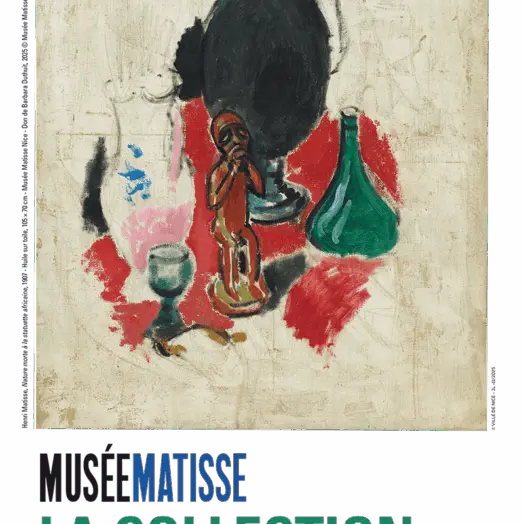
Since the museum's inauguration, the collections have been constantly enriched. A chrono-thematic tour, spread over four levels, reflects their diversity and highlights recent acquisitions, including Nature morte à la statuette africaine (1907), and the deposit, by the Centre national des arts plastiques, of four aquatints from the late 1940s.