





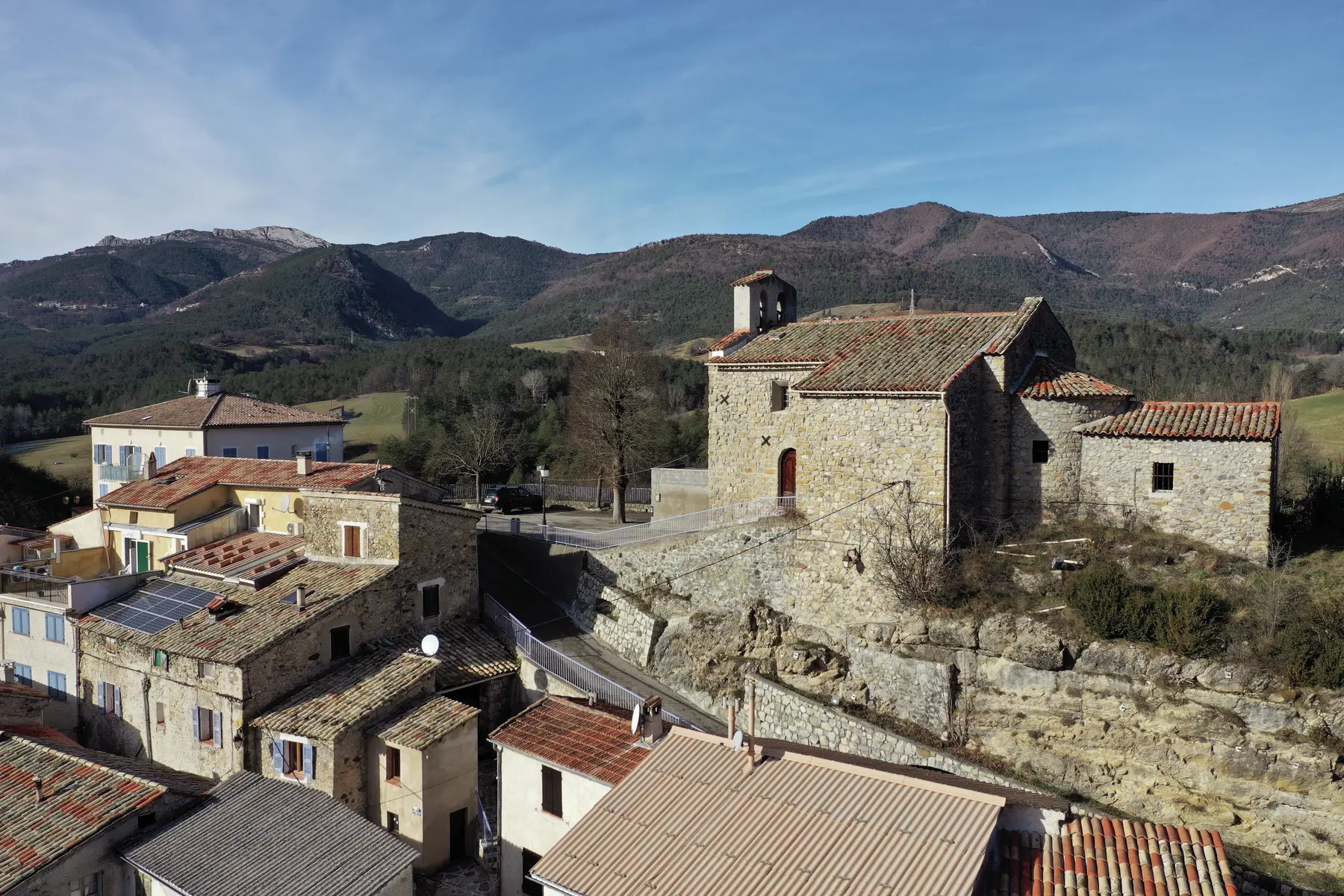

Description
Church with features of Romanesque architecture
History
Historical Description:
The Church of Notre-Dame may be the parish church that served both Les Mujouls and Collongues, mentioned in 1351 among the benefices of the Bishop of Glandèves. It may not have been built until the second half of the 13th century or the first half of the 14th century, as the Church of the Holy Sepulcher in Mujouls—mentioned as early as 1079 in the temporal records of Saint-Victor Abbey in Marseille—had served as the parish church until that time. The building’s architecture is consistent with this proposed dating. At the time of its construction, the church had a simple layout consisting of a single nave ending in a semicircular apse. A first side chapel was added on the north side, perhaps in the late 15th or early 16th century. A second side chapel was built on the south side sometime during the 17th or 18th century. A sacristy was added on the east side, extending from the apse, after 1835.
Architecture
Architectural Description:
The current building consists of a nave flanked on the north and south by two side chapels and ending on the east with a semicircular apse. A sacristy was built as an extension of the apse. A bell wall with two arches surmounts the western gable wall. The nave is covered by a false barrel vault with openings, while the apse features a masonry cul-de-four vault. The side chapels have barrel vaults.
The door opens into the south side wall, west of the side chapel; it is spanned by a semicircular arch. The central opening of the apse was removed when the door leading to the sacristy was cut through; a rectangular window, located on the south side, now provides light to the apse. Another rectangular window is set at the top of the south side elevation of the nave. A narrow opening is cut into the top of the western gable wall.
The nave and the apse, in their unaltered sections, are constructed of medium-sized ashlars of local stone, roughly dressed with a hammer. The north side chapel features roughly laid stonework; its corner courses are formed of blocks carefully dressed with a chisel. The south side chapel and the sacristy are built of rubble masonry.
Source: C. Poteur (Castrum)
Openings
All year 2026 - Open on saturday, on sunday
Location
Plan interactif : 1 lieux répertoriés.
- Lieu sans nom
Spoken languages
Spoken languages
