






Description
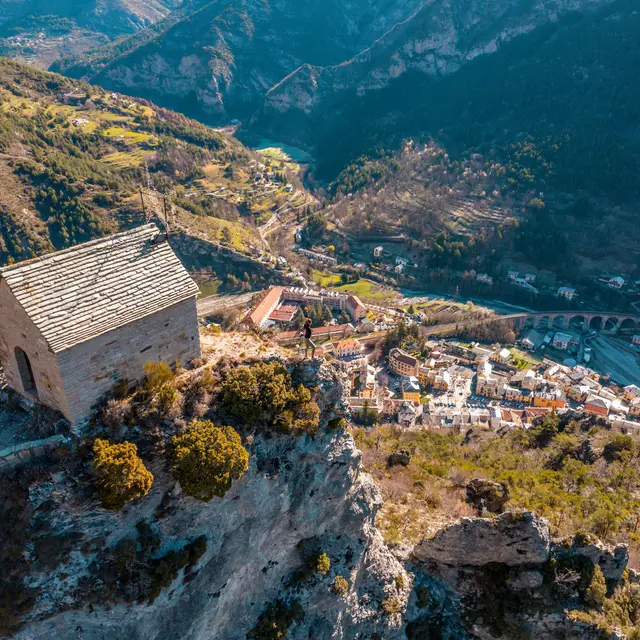
Perched at an altitude of 1,100 meters, the medieval Saint-Sauveur Chapel overlooks Tende and the Roya Valley. It is notable for its Lombard Romanesque architecture and its remnants of Byzantine-inspired paintings.
Located at an altitude of about 1,100 meters on a narrow ridge ledge, the Saint-Sauveur Chapel overlooks the village of Tende by about 300 meters. Perched on a rocky promontory, it offers a remarkable panoramic view of the entire Roya Valley.
This modest medieval chapel, dating from the 13th century, consists of a single nave covered by a broken barrel vault, extended by a semicircular apse. A small semicircular window with splayed jambs illuminates the apse. The roofs are covered with slate tiles.
The facades feature meticulous masonry, consisting of courses of thin stones of varying sizes, characteristic of Lombard Romanesque architecture. The building is distinguished, however, by its decorative simplicity, lacking pilaster strips or friezes of carved arcades.
The interior plasterwork has largely disappeared due to weathering and water infiltration during the chapel’s long period of abandonment. Several remnants of wall paintings, however, remain visible.
The transverse arch separating the nave from the apse retains traces of a painted frieze. On the left wall of the apse, three figures remain, including one blessing in the manner of Christ, with his right hand raised, two fingers extended, and holding a scroll in his left hand.
In terms of their iconography and execution, these depictions are part of the Byzantine pictorial tradition. A horizontal frieze once dominated this figurative ensemble. Particularly rare in the region, these remains constitute a remarkable artistic testament and enhance the building’s heritage value.
The history of the chapel remains poorly documented. Its dating is based primarily on an analysis of its construction techniques and painted decorations. Its construction took place against the backdrop of 13th-century territorial rivalries. In the middle of that century, the Counts of Ventimiglia ceded their rights to the Roya River to the Count of Provence. Challenging this decision, Pierre-Balb and Guillaume-Pierre of Ventimiglia settled in Tende, where they built defensive structures and opposed Provençal authority. In 1261, Guillaume-Pierre married Eudoxia, daughter of Theodore II Lascaris, Emperor of Nicaea. Their descendants adopted the name Lascaris.
Long abandoned, the building was in an advanced state of disrepair. Its poor condition was reported in 1927 to the Superintendence of National Monuments in Turin. Preservation work was finally carried out in the 1990s.
Access to the chapel, which in some places consists of steps carved into the rock face, is an integral part of the site’s uniqueness.
Services
Pets welcome
Not open to the public
Accessibility
Not accessible in a wheelchair
Rates
Free access.
—
Openings
All year 2026 - Open everyday
To preserve this site and its interior, the chapel is closed to the public. To learn about its history and find out more, there is a QR code on the door.
Location
Plan interactif : 1 lieux répertoriés.
- Lieu sans nom
Contact Saint-Sauveur chapel
Spoken languages
Spoken languages

Environment
Environment
- Mountain view
- Panoramic view
- Mountain location
- Isolated
- Village -2 km away
