




Description
On the death of his wife Yvonne in 1957, Le Corbusier drew a burial for burial. In 1965 he joined his wife as he had always wished.
On March 25, 1958, Le Corbusier obtained a 30-year concession from the mayor of Roquebrune for 4m2 plots J n°3 and n°4.
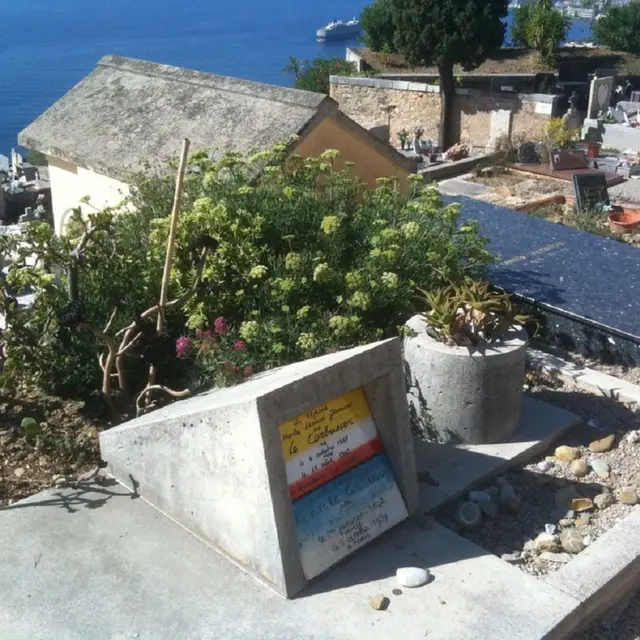
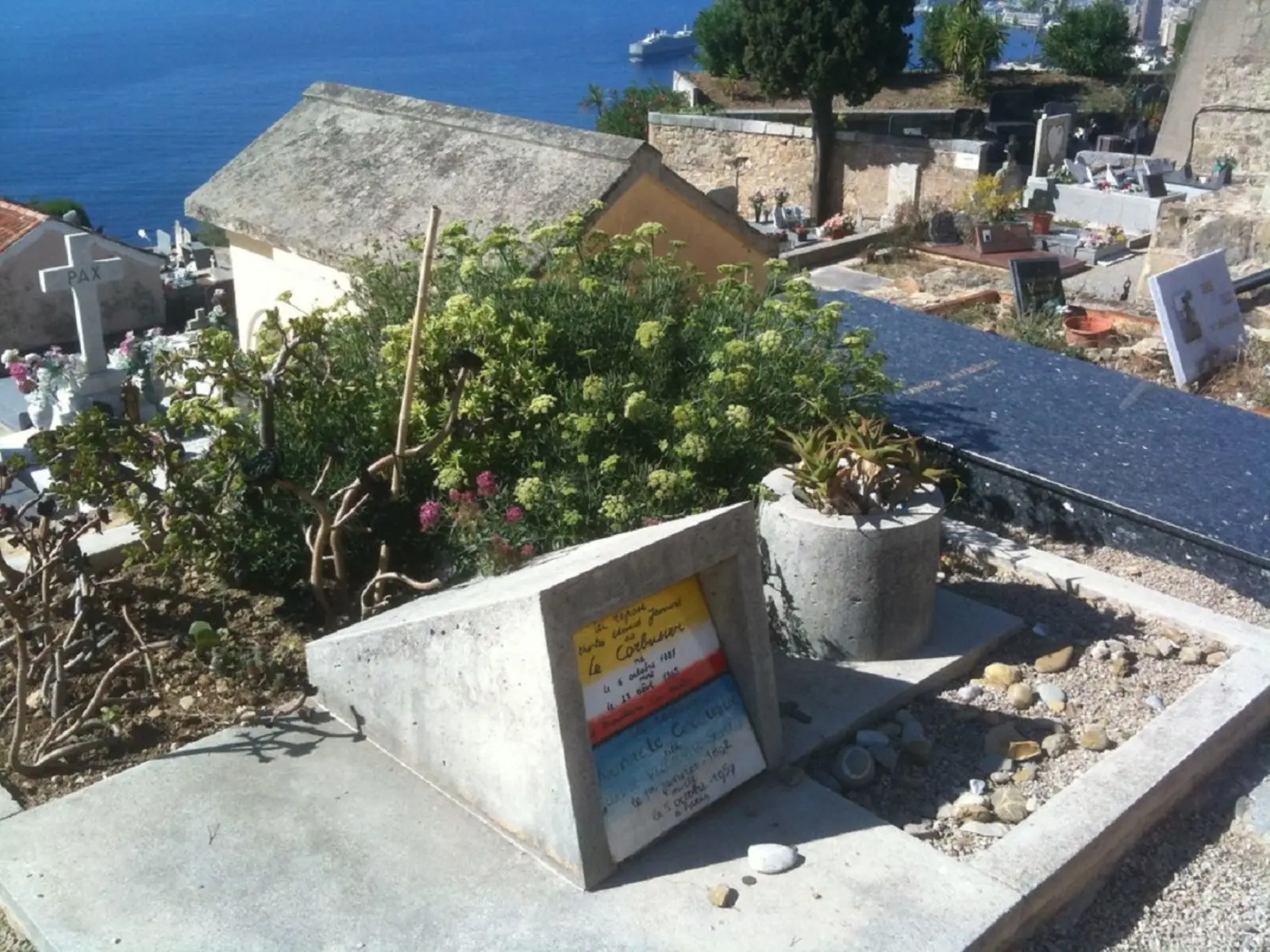
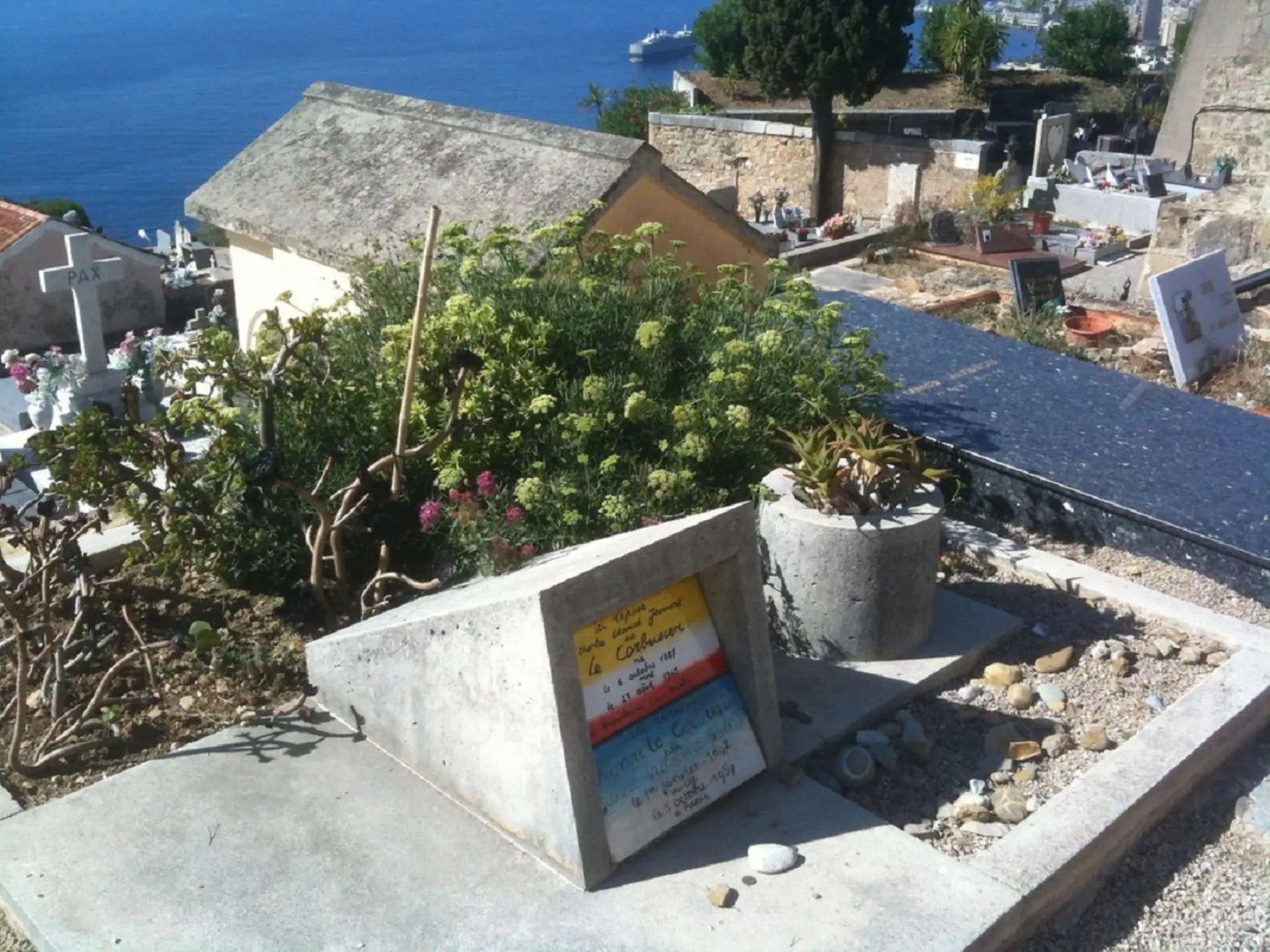
To build the tomb, Le Corbusier called on his friend, carpenter Charles Barberis, to create the formwork, and on mason Salvator Bertocchi, who was in charge of the stone-cement slab; Robert Rebutato was responsible for purchasing the various materials. The enameller Jean Martin was entrusted with the production of the two white email plaques. Yvonne's epitaph was painted on the lower plaque, which Le Corbusier enhanced with blue to recall the sea. On the architect's death, the upper plaque will be replaced by one embellished with yellow and red, symbolizing the sunny, glowing sky.
"I drew up a design for a funerary slab bearing a prismatic projection 53 cm high × 43 cm wide, the top sloping from 53 cm to 10 cm at the other end. The projection is therefore 70 cm long and 43 cm wide. As my wife's ashes are to be placed here, this will serve as a closure" Le Corbusier to the Mayor of Roquebrune Cap Martin, May 16, 1958.
On the side of the projection, Le Corbusier masoned a cylindrical vase reminiscent of the purist compositions of the 1920s, while adding geometric complexity to the construction. As for the slab, it's not solid to leave enough space for plants. Finally, to adorn the slab in a minimalist manner, Le Corbusier printed the shape of a shell and inlaid Yvonne's bronze cross.
Rates
Free access.
—
Openings
All year 2026 - Open everyday
Location
Plan interactif : 1 lieux répertoriés.
- Lieu sans nom
Spoken languages
Spoken languages

Environment
Environment
- Panoramic view
